Hey balance bestie, it’s Leah Remillet. Welcome back to Balancing Busy! Okay, so last week we talked about romanticizing your to-do list and how adding joy, making things beautiful, celebrating the wins—all of it can help you fall back in love with the work instead of just grinding through it. And I still feel that energy so much.
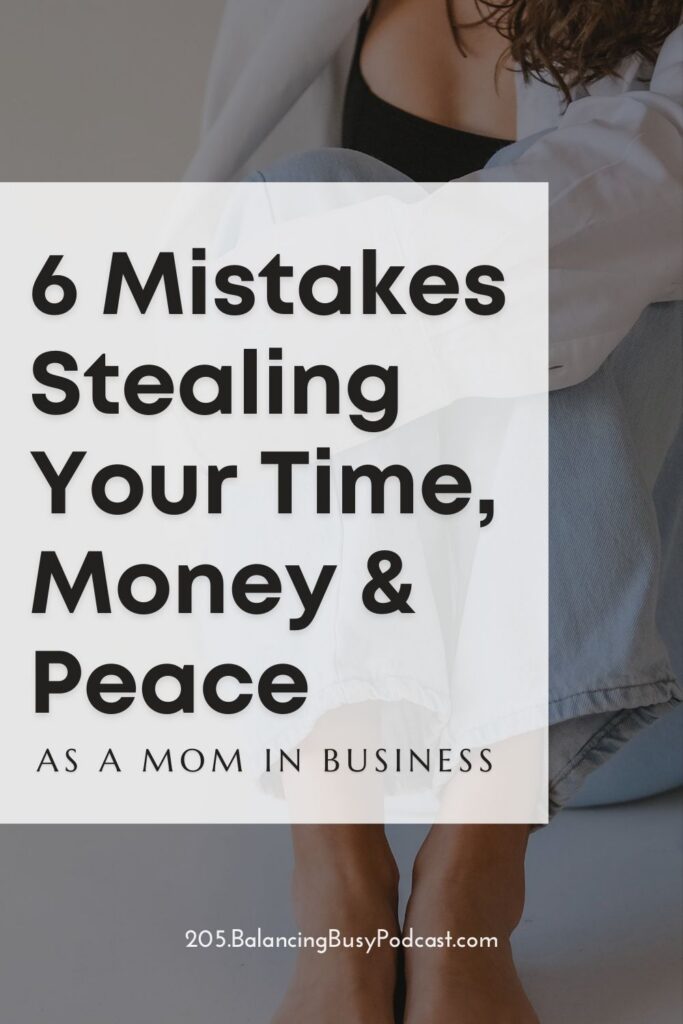
But today I want to get really honest with you, because even with all the intentions and the cute pens and the joy tasks, I’ve still made some massive, expensive mistakes in my business. The kind that hurt my bank account, my confidence, my time with my family, and honestly, my peace for a while. I’m not sharing this to beat myself up. I’m sharing because I wish someone had sat me down years ago and said, “Hey, these are the traps that will cost you big. Do not step in them.”
So if you’re listening and you’re in the middle of building or growing your business while juggling mom life, this is me pulling you aside like, “Girl, let me tell you what I learned the hard way.” And as I started writing out, “Okay, what were my biggest mistakes?”—these were front and center. They just came instantly to me.
Number one: I did not plan for taxes. Like, at all. I hadn’t really made money and so I didn’t really have to plan for taxes. And then I started making real money and it cost me thirty-six thousand dollars in one hit.
Okay, this one still makes my stomach flip when I think about it. For years I was like, “I’m not good at numbers,” and “I’ll just hand it all over to my CPA,” and “I don’t know.” And yes—famous last words. I got a tax bill at the end of the year for thirty-six thousand dollars. Turns out, with better planning—quarterly estimates, deductions that I didn’t even know about, that I completely qualified for, strategies that are totally legal and normal—it could have been closer to zero. Zero! But I avoided it because I didn’t feel confident, so I just… didn’t look. And then it snowballed.
But wait, it gets worse. Because that same blind trust thing happened again. And it happened to be again around my taxes. We were closing on our house. And I’m thinking everything’s fine because my income is solid, right? Nope. Turns out the CPA never filed my business taxes and I had never followed up. I’d never checked. I just assumed, “Everything’s good. They’ve got it. I don’t need to pay attention at all.” So my income wasn’t showing on any records. It couldn’t be verified and we almost lost the house over it.
I was panicking. They were explaining to me my tax returns were missing, and then I had to go do digging and then come back and be like, “Oh my gosh, it’s my CPA’s fault.” But really it was mine, because I should have confirmed. It was humiliating and so stressful. And it cost me time and money and too much sleep.
Here’s what I do now. I still have a CPA—a new one who I absolutely love. I also have a tax strategist who is phenomenal. And I educated myself on the basics. While I am definitely no expert, I’m also not completely in the dark. If something feels off, ask questions. No more handing over the keys and just walking away.
Number two: Avoiding new technology because it feels intimidating. And we hear this get manifested in different ways. “Oh, I want to keep things old school.” You’ve heard the different ideas. But if the honest truth is you’re avoiding new technology because, well, you just don’t really know how to use it and that learning curve feels uncomfortable—I am telling you, take the time. Sit down. Learn it. Figure out if it can make a difference for your business.
An example of this would absolutely be utilizing AI. And yet, by avoiding it, you are making your work take so much longer and your life be harder than it has to be. I actually saw this play out this last weekend. One of our friends asked a bunch of us girls to help her craft the way to say something on an invitation. She was basically trying to figure out how to say—for her son’s birthday party—that he’s kind of at that age where he doesn’t really want toys, but he would love cash, but she doesn’t want to sound obnoxious or rude being like, “Just give my kid cash.”
So she was asking us how she should write it on the card. And I’m like, “Girl, just feed that into chat and have it write out a single sentence.” And she admitted that she had never used ChatGPT. And I’m like, “Okay.” I pull out my phone and I’m like, “Let me show you how we’re going to do this.” The amount of time that she’s been worrying about this, that she’s been thinking about this, that she’s been like, “Oh my gosh, I haven’t sent the invitations out because I don’t know how to say what I’m trying to say”—and it could literally be written for her in half a second by utilizing new technology that is available and waiting for her.
Okay, so if this resonated with you and you’re like, “Yeah, I’m one of those people not utilizing AI the way that I could, and I have the sneaky suspicion that it would make my life so much easier”—you are absolutely right. And I don’t know when you’re listening to this podcast episode, but if you’re listening to it the week that this episode comes out, I am teaching a free class this Thursday on how to cut your hours in half utilizing AI. I have one hundred spots available. That’s it. But you can claim one of them if we still have spots by just going to leahremillet.com/training.
Now, if you’re hearing this later and you’re like, “Dang it, I missed that, I needed it!”—don’t worry. You can still go to the URL, jump on the waitlist, and as soon as I teach it again, you’ll be the very first to be able to grab one of those spots. There are only one hundred spots. I don’t know when you are listening to this, but I promise you are going to love this class. This is going to help you simplify, stop overthinking, make decisions quicker, more efficiently, and be able to focus back in on the money-making activities. In fact, get better ideas for making more money.
Oh my gosh, if you are not utilizing AI, this is going to change your world. And if you’re kind of utilizing it—like you’re like, “Ah, I haven’t really done the work to figure out how to use it right. I’m basically utilizing it as a glorified Google”—again, this is going to blow your mind. So go ahead and get your spot, or you’re going to be getting it very soon because I’ll offer it again soon. Go to leahremillet.com/training.
And here’s the thing. Yes, we are definitely seeing this right now with AI. But I have seen this so many times. You’re resisting jumping into the newest social platform because you’re like, “Oh man, I don’t want to learn one more thing,” or you’re resisting jumping into utilizing AI because you have this story about how it’s not going to be authentic enough. But you get to make the rules. You get to decide how you’re going to use any of these technologies. But when we avoid them, we get left behind. You do not want to be left behind.
Number three: I waited way too long to outsource because I thought no one could do it as good as me. Classic perfection trap. I was doing everything—email, social media, graphics, admin, customer service, all of it—because “it’s faster if I just do it myself.” You’ve heard that, or you’ve thought that. Or maybe you’ve thought this: “They won’t get my voice right. They won’t do it as well as I can do it. They won’t put in as much love as I do.” Meanwhile, I was spending hours on tasks that drained me and my family was getting the leftovers.
Here’s what I need you to hear. If you want to increase your income, you must focus on the money-making activities that will do that. And you need to give yourself permission to outsource the tasks that honestly anyone can do. If you could train a teenager, then let them do that work. This is the difference between scaling and staying stuck.
And here’s the part that I completely missed and I wish someone would have explained to me. So I am saying this to you: You can start really small. One task. One person. And test it. Don’t try to outsource everything all at once. Don’t try to give your new virtual assistant, or whoever it might be, all the tasks. Give them one single thing. Let them learn how to do that. Let them take that off your plate, and you invest that time you would have used into money-making activities. That’s how you ensure that A—you can afford them, and B—that you feel good outsourcing.
Once you’ve got that down, add one more task. And one more task after that. You look for the areas in your business where you admit you could pay minimum wage for that work. You are the CEO. You should not be doing minimum wage work. I remember when someone said that to me and it stung because they were real blunt. But it’s so true. I outsource anything that’s repeatable or not in my genius zone.
But I do have this one caveat where I think it’s really important to try to learn for yourself. This is that whole me learning really hard lessons because I just tried to outsource or hand it over because I was intimidated. Now I force through the intimidation. I make myself get a general understanding of it, and then I’ll outsource—because that way I know what to look for.
Bottom line: outsourcing is not lazy. It is a strategy. And by the way, if you know you need outsourcing—like this is your next step, but it feels very daunting—I have two podcast episodes, a part one and part two, that explain everything about outsourcing. It’s literally titled “Outsourcing Explained.” This used to be a paid course, but I was like, “No, you know what? I am just giving it to everyone because mamas need this.” So you can go to 28podcast.com and listen to part one, and then of course 29podcast.com to listen to part two.
Number four: I didn’t build systems. Because I didn’t take the time to build the system, I wasted hours and hours repeating the same things over and over. This is math that hurts. Setting up the system is going to take time, and what really gets us stuck is we’re not exactly sure how much time. We’re hoping ninety minutes. But what if we get stuck on something? What if it takes longer? And we decide that we don’t have that kind of time.
So what we do is we keep giving thirty minutes, thirty minutes, thirty minutes—but we’re stacking those on top of each other instead of taking the couple hours to just create the system that could automate it all moving forward, every single time.
Now I ask, “Is this a one-time thing, or is this going to be repeatable?” If it’s one of those repeatable things, then I spend the time to build the system, the template, the automation, the SOP—which I call them BOBs, which stands for Best Operation Breakdown, versus SOPs, which is standard, because I’m not doing anything standard. I want to do everything at the very best version for my clients.
But my point is: the template, the workflow, the nurture sequence, the automation—whatever that is that you are sitting down and doing manually because you’re intimidated by taking the time to just set it up as a repeatable task that works behind the scenes for you—make it happen. Block that time so that you can create the system or the automation or the template, so that instead of you sitting down and taking fifteen minutes, twenty minutes, thirty minutes—which stack on top of each other because remember, this is a repeatable task, something you’re doing all the time—instead, you set it up one time so that moving forward, your life is so much easier.
Number five: I did not set clear boundaries in the early years, and it bled into every part of my life. You’ve heard the stories. You know I had no hard stop time. I was working weekends. I was answering emails at ten PM, saying yes to everything because I didn’t want to disappoint anyone or miss any opportunities. I told myself it was hustle, but it was just burnout. And hustle does not work. It is not sustainable, especially for moms.
My marriage felt strained, my kids got short-tempered me, and I started resenting the business that I really did love. I just couldn’t feel it anymore. Now I have non-negotiables. There is no work after seven PM. Okay, actually, it’s more like four PM. Weekends are sacred. I protect my energy like it is the most valuable asset—because it turns out, it is. And guess what? The business never fell apart.
Boundaries aren’t mean. When you say yes to that work thing, to that obligation, to whatever it is that in your heart you knew you should have said no to—there is someone who’s being disappointed. And it turns out that it usually is the people who we say matter most.
I believe that we as women need to support and help each other in the process of setting better boundaries. We need to help each other by saying, “No, I’m not going to let you take that on. You need to be able to go home. You need to be able to be with the family.” Or we need to do a better job by setting the boundary and communicating it so that we can show other women: this is acceptable. This is allowed. This is how together we do a better job protecting one another. So I’m going to say this again. Boundaries are not mean. They are a protection for the people who matter most to us.
And the last mistake I want to talk about is that I softened my message for too long. I tried to be everyone’s cup of tea so that I wouldn’t scare anyone off or offend anybody. If you’re trying to be everyone’s choice, hear me: you will end up being nobody’s first choice. And that means you have to start lowering your prices, because now you’re competing on price—you’re not competing on your expertise.
When we try to be everyone’s cup of tea, nobody ends up wanting to pick us. We need to be willing to take a stand. I want to be clear about who I help, what I believe—joy over hustle, that faith is everything to me, balance over burnout, that family is the most important thing, and that any success that you have, if it is at the expense of your home, will never be worth it. Not ever. And I’m okay if some people walk away. The right ones stay, and they’re the ones who light me up.
So here is the truth that I have learned after years of building a business as a mom. These mistakes—they didn’t happen because I wasn’t smart or capable. I wish someone would have told me that right after I’d made them, when I just felt honestly like an idiot. They happened when I stopped trusting myself, when I avoided the hard stuff, and when I let fear or hustle culture run the show.
But fixing them, mama—that’s what reclaimed my time, my joy, and my revenue. Balance isn’t fluffy advice. It’s strategic removal of what drains you. It’s ruthless trust in your own intuition and systems that actually work. I’ve built them, I live them, and I know they change everything.
So this is my quick challenge for you this week. Pick one area. Maybe it happens to be taxes or outsourcing or boundaries, whatever. And just ask, “What’s one small step that I can take right now to avoid my version of this mistake?” Just pick one thing and do it this week, and watch how much lighter you feel. Because that’s what I want for you. I believe in you, and I will talk to you next time.
Hide Transcript

























you said: